projects · deepfield capital
A virtual fund run by AI agents.
Deepfield Capital is my one-person investing experiment. A small team of AI agents studies Japanese stocks around the clock, at a scale no single person could. The name comes from the Hubble Deep Field, the famous photo astronomers took by pointing the telescope at an empty patch of sky and looking properly.
the idea
Japan’s stock market has about 4,400 companies, but professional analysts only really follow the famous few hundred. Most of the rest never get read at all. I wanted to see if a team of AI agents could read everything, and give one person the kind of research power that used to take a whole firm. For now it’s just my own experiment, run by software.
the daily loop
- 06:00 Check the news
Before the market opens, an agent reads the overnight news for every stock we hold. If the reason we bought something no longer holds, it sells.
- 16:30 Scan everything
After the market closes, an agent goes through all ~4,400 companies on the Tokyo stock market. It reacts only to a few specific events that years of market history say actually matter, like a company announcing that same day that it will buy back its own shares, or one of a shortlist of activist investors revealing a big new stake. Fresh news only, because the advantage fades within days. At most eight names a night make the cut.
- 19:00 Read, then argue
One agent reads those companies’ official reports and writes up the case for buying. Then a second agent, deliberately a different AI, tries to tear that case apart. Only the ideas that survive the argument get bought.
- 21:00 Count the score
An agent adds up how the portfolio did, what the whole thing costs to run, and how the stocks it passed on performed. The misses teach as much as the hits.
- sundays The weekly verdict
A final agent reads back through the whole week and answers one question. Does the experiment deserve another week?
how it learns
Every company the fund examines, bought or skipped, goes into a shadow book, and a script checks weeks later how each one actually played out against similar companies. On Sundays the agents themselves get graded, and every closed trade is judged twice, once on process and once on result. What gets learned is written into a small set of files the agents read before every decision, so last month’s lesson shapes tomorrow’s trade. Nothing updates itself though. Changes are proposed with written evidence, capped in size, and I approve each one. A lesson also has to age for sixty trading days before it counts, so the fund never grades itself with hindsight.
It has already caught one of its own mistakes. The buyback signal started out with a measured edge of 2.5 percent over two months, but a stricter re-test cut that to 0.7, and only when the news is caught the same day. The slower version was retired, and the reference table was rewritten so the old number can never be cited again.
architecture & stack
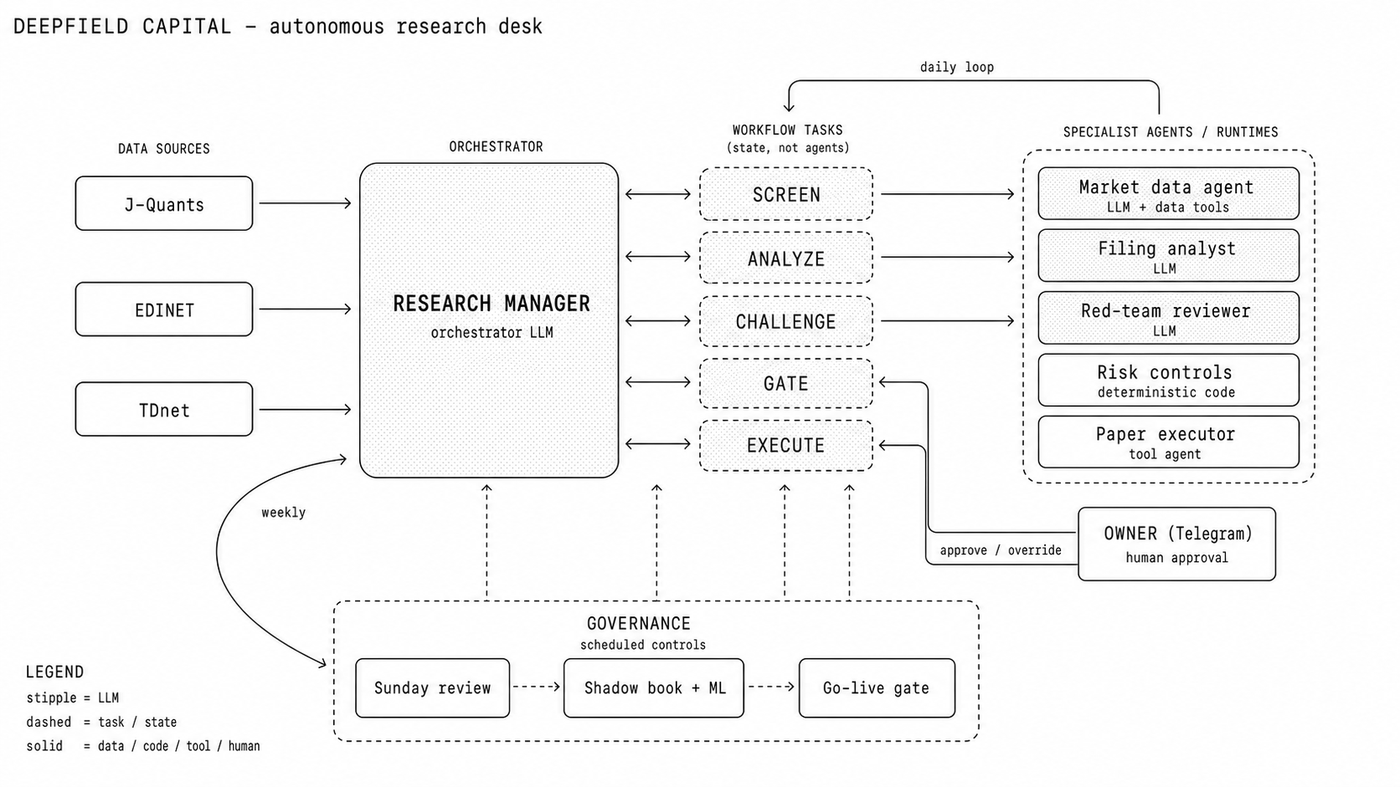
The fund runs 24/7 as a single agent persona named Ken, and I talk to it over Telegram like a colleague. It lives on a cloud PaaS with all of its state on a persistent volume. Python and shell scripts run under an agent framework, and a git push deploys. The work is split between two kinds of models. Frontier Claude models handle the heavy judgment, like reading filings and reviewing investment cases, while an open-weight model runs the screening and orchestration. And there is one hard rule. The skeptic never runs on the same model as the analyst, so no idea is ever graded by the brain that wrote it.
results so far
The fund has been running since July 2026 with ¥1,000,000 of virtual money, trying to beat the TOPIX, Japan’s main stock market index. In progress…
or 0xjinsoma@gmail.com · I like meeting curious people.